Showing posts with label Capitalism. Show all posts

Thursday, 2 March 2017

Mona Lisa, Adam Smith & The Success Equation

Here's an experiment. There's Rafiki holding Simba up above his shoulders. Do you think you'd define success the same way as Rafiki did in the Lion King? Picture credit: The Lion King
“College di gate de is taraf hum life ko nachate hai… te duji taraf life humko nachati hai,” said Aamir Khan’s character DJ in the movie Rang De Basanti with his unkempt hair. While it’s a complex web that forms the amorphous dance floor of life that forms the stage for DJ’s dialogue, this essay really just focuses on how capitalism interweaves a major part of that dance floor and affects how ‘successful’ and happy one is.

The Backstory
A friend at work prompted this subject when she was writing about ‘decoding success’. It made me think too - in our capitalistic world, how do we define success? What is success and is it the same everywhere and every time? Let’s say everything about us – professionally and personally – remains constant. Now, would you be happier if you were in free-market heaven US? And what about tightly controlled North Korea? Would the same professional achievements lead to the same idea of success? Would the ideological drive override the thirst for material success?

Or would you be happier if you’d achieved it all in the blooming 1960s than now? Try this with a few more questions and you’ll probably agree that what we call success could be so different in these different times and circumstances. So it’s so much a product of a varying set of factors that include material success, professional achievement, ideological drives and more. Perhaps Maslow’s hierarchy of needs would have so much to add here.

Anyway, let’s get back to capitalism for now. There’s little denying, that today, capitalism is the force that influences our personal lives, professional decisions and more importantly our political and economic systems. While there’s opposition to it, it mostly does find a way to call the shots, in part or as a whole. The fact that success is more often than not defined, or at least described, in terms of material success and wealth generated is testimony to hoe much capitalism affects our lives.

The Mona Lisa, perhaps the most
famous painting in the world, was painted
by Leonardo da Vinci in the 1500s. But
do we call Leonardo a gifted,
master artist or a successful artist?  
Think about it. We talk about great artists who paint or have painted masterpieces, gifted musicians who make restless souls come alive and beautiful minds of scientists who make astounding discoveries among other things, but we hardly ever call use the word successful when talking about them. The usual words reserved for them are gifted, great, beautiful, unconventional and legendary et al. Successful is, however, mostly reserved for those who excel in terms of creating businesses, achieving professional heights and accumulating wealth. Isn’t that capitalism playing on our minds?

So capitalism shapes the world around us in such a manner that it influences so many of our decisions, including about our work. Jeff Hammerbacher, the man who’s credited with coining the word data science, also had another important set of words to say. In this ‘post-truth’ era though, I really cannot guarantee if he said it, even after some research. Anyway, what he supposedly said was, “The best minds of our generation are thinking about how to make people click on ads.”

While not all great minds may be preoccupied with creating click-baits, that one-liner is really quite telling. Doesn’t that tell you how much capitalism influences our ideas and our professional choices? And clearly, what affects our professional decisions is bound to affect our happiness quotients as well. Quotient! Look it me trying to quantify happiness, another gift of capitalism maybe.

Adam Smith was the first to spot
the invisible hand. Aren't invisible
things difficult to regulate? 
So where does capitalism derive that power to affect our happiness then? Well what’s inherent to capitalism is laissez-faire – the idea of a free market where private ownership is the boss, where things are left free to take their own course. Here, it’s the invisible hand, as Adam Smith wrote centuries ago, that runs the show.

And as this invisible hand pushes people to maximise profits, it provokes competition. So while it implies that the quality of products and the costs of production are constantly worked upon and innovation thrives, it also sparks a fear of missing out (FOMO in our lingo today) and often kills the idea of taking things slow. (There are other issues with capitalism too, but this essay doesn’t contend with those.)

An Individual’s Conundrum
So while it is good for economic prosperity and should ideally be self-moderating, capitalism has other by-products in terms of how it affects individuals professionally, personally and emotionally. Of course, one may also argue the other way, that it also has its rewards. Individuals reap the benefits of professional success too then and amass wealth. But that’s just capitalism’s nature; the price payers always outnumber the beneficiaries.

While desks today look cleaner with the advent of
computers, the work load has perhaps only risen.
Or is your desk still as messy?
Picture credit: Carrotstown
Professionally, it pushes people relentlessly and can lead to individuals burning out – physically or mentally – as they are being driven by their immediate needs, the invisible hand and the social contexts around them. And like the click-bait example shows, it literally can make people opt for peculiar yet paying jobs that may not make one happy. Now tell me, how many times have you sidelined something you loved to do for a job that paid more?

Personally, it just takes away so much of your time. It makes you work more. Perhaps one the top economists of all time, and a ‘successful’ one too given his stock market adventures, JM Keynes had predicted almost a century ago that as our economies develop, our future generations will have to work less and less and will have more time for leisure. Well, wonder what happened. Most of us have really just been working more. 

Sacrificing those Saturday night plans with friends for
the work meeting to crack a deal for the company.
How tough is that choice? 
Working more is great when passion and interest are combined, but most people aren’t that fortunate. And even for the ones who are, work really knows ways to get the better off them. Haven’t you been forced to call off Saturday night plans with friends for work? It’s easy to see now where DJ was coming from with that Rang De dialogue.

And well, we all know how all of that can play on us emotionally. While some thrive of professional challenges and entrepreneurial adventures, for many professional burdens can hurt our state of mind, and our relationships. Professional ups and downs really affect us, and the feeling of being in a perpetual maze or race can leave us distraught and isolated. And while we all have our coping mechanisms, don’t we need a little more than those?

The Success Equation
It’s a cost then, which is attached to the prize. In our individual quests for professional success, we are often told hard work is the only option. Even so much of the content we consume suggests the same – let's look at Suits where the Harvey and Mike are always shown working till late in suits while their personal relationships are underplayed – or the exact opposite in form of an escape from it all  for instance Two And A Half Men where work was hardly ever featured.

And while hard work is not something to shy away from, it’s important to prioritise amidst our individual and combined struggles to achieve economic prosperity and emotional happiness, because aren’t those, in their subjective proportions, crucial conditions of being 'successful' in life, as we know it today?


Will I sleep better if I complete that presentation for office in time or will I be happier if I play with my unperturbed beagles in the mud for a little while? Such tradeoffs, it’s almost criminal. And while capitalism will always prioritise profits, shouldn’t we prioritise happiness as well? And the twain shall only meet in a fine balance, if at all. While they derive so much from one another, they can also turn on each other.

We are all born different. So while we can have common
measures to contextualise success, can we really have a
universal set to define it? And more importantly, should we?
Picture credit: Maya Eye Photography
So how one defines success may always be a function of our achievements, our emotional wellbeing (those are so subjective too), the tradeoffs, our ideological inclinations and our backgrounds. There can be so much too. While to some the achievements may outweigh the tradeoffs, to others the tradeoffs may be heart wrenching. To many ideological drives may define their route to success, to others material wealth may be paramount. 

And while I’ll let you work on your own equation of success, let’s look at success as a combination of elements and in the context of the times and ideas that shape our world. Only then perhaps, will we really be able to answer, how 'successful' we are. And however far or close one may find oneself to that 'success' and its contributors, do keep working, but perhaps in a different way, and maybe even on a different thing, because work still will always remain one of the keys to whatever we call success in the end.


PS: The essay title itself may have been click-bait here. Couldn't resist. Also, the use of the words cost, equation and quotient among others in this essay are by themselves also indications of how our minds (at least mine) have been attuned to evaluate things in life – in form of (two-way) transactions, even when we have Mastercard ads on loop, reminding us that some moments in life are ‘priceless’.

Friday, 15 July 2016

Nightmares Of A Dating Platform Co-Founder

A picture from the first event of the Pop Culture Panchayat Series we hosted in New Delhi. Connecting people, does Nokia still hold a copyright to that tagline? Picture Credit: MYOLO

India is growing and it is growing fast. At least that’s the narrative the Indian government wants you to swear by. While I see some of that economic growth happening, I also think the we should look at the growth digits with a pinch of salt. But it’s some non-economic activities and events that tend to throw me back to a Thursday that I’ve never lived.

The Bollywood movie ‘Udta Punjab’ and the drama around its clearance and censor board chief’s medieval whims is one such socio-cultural piece in the larger painting, which to me was open-sourced earlier, but now appears to be more restricted. There are many such examples, people will tell you. Some will also tell you most of these are futile. So it depends who you choose to believe.

Without getting into the argument of why art demands, deserves and needs freedom and why the state is better focusing on poverty alleviation, I want to declare that I write this article as an Indian co-founder at a startup called MYOLO where we are building an online/offline socialising and dating platform.

It’s a platform we are building for the urban Indian man who is as much of a feminist as he is a lover of Virat Kohli’s straight drive. It’s for the young woman who is as much aware about Raghuram Rajan and his refusal of extending his term, as she is aware of the latest maroon lipstick shade from Mac. It’s as much for the queer person who marched at JNU for the Orlando massacre victims as it is for the transgender who practiced yoga who practiced yoga on the International Day of Yoga in Mumbai. It’s for everyone who fits some of these super stereotypes and for everyone who doesn’t. Essentially, it’s for the young independent thinker on the move, for the intelligent Indian.

Dating Platforms and Urban India

See, to us and our startup, the openness of the young Indian mind matters as much as the accommodativeness of society. By accommodative I don’t mean to give society an upper hand, it’s only to indicate the evolutionary nature of it all, among others, the nature of relationships, the mediums of realising it and of course the idea of marriage. And to be honest, while we believe we’ve got our target audience sorted, I think that audience is only growing by the day, especially with exposure to education, information on the Internet and the works of artists, authors and the likes from around the world.

Education is playing a key role. So is economic growth. No, not the forcing of Rana Pratap in Rajasthan history textbooks kind of education, but the kind of liberal education that is coaxing people to question that move. For instance, I think, (while both are welcome) today an article from the Spoilt Modern Indian Woman contributes more to advancing the cause of feminism than a lecture at a school function. Not only that, and you don’t need a genius to know this, with increased economic growth, there’s increased exposure and access to private education, the Internet and books and what not, and that in itself feeds into that cycle of more liberal students coming out as well. See, it’s not because joint families are breaking, but it’s because more families are getting educated too. So while we target higher economic growth, we shouldn’t try to paint and then chain our values. No, the time of Asian values is gone.

While societies are progressing (yes, we can argue about how we define progress), there are social elements that are going primitive too. Just so complex is India; actually the entire world. So many divides. For every stereotype-breaking campaign by a dating app (yes, I think the new Truly Madly AIB video song is great), there are thousands of Bhai fans who cannot see why his “raped woman” comment was wrong. And that’s just the unfortunate disparity of thought in the urban space. The rural has even more shades.


Online dating is perhaps in a need for correction, correction to nudge it back towards keeping things real. Why just stay stuck on messengers when technology can also lead you interesting events? Picture credit: BBC 
Okay, so let’s get to what prompted this post. It was this – this report claiming that the ninth edition of the travellers' guide and scholars' manual released by the Indian Council for Cultural Relations (ICCR) says that Indian women are still conservative, that they don’t really date. This one apparently even goes on to say, “The modern Indian woman is traditional in some ways. She may refuse politely if a man asks her out for a film or an outing. Dating is not common in India.” So what’s the deal? No, I’m not an Indian woman, but I’ve dated one for seven years. And I know now you are judging her and me, but the sourness in that analysis may lower if I tell you we got married after that dating period too.

Forget that though, why that statement? Why should we want to distance ourselves from dating? Even if it were foreign concept, it’s a concept we love and have embraced. It’s empowering to choose your partner. It’s fulfilling to love them. It’s more. Doesn’t even have to be eternal love, it could be a summer fling too where neither party was hurt or cheated. So it’s also nothing we are ashamed of. Meanwhile we should also remember that India is also now home to it’s own take on love hotels with Stay Uncle coming to the rescue of “couples that need a room, not judgment”. A much needed venture. And so, while the ICCR statement isn’t true of urban India, let’s say if it were true. Let’s say most Indian women didn’t date, but then the men do. Nothing saying there that they don’t. So are we saying that most Indian men are gay? Well, yes, I want a government body to acknowledge and embrace homosexuality in India, but don’t do that like a hypocrite now? I want you the state to embrace heterosexuality as much too. In fact, embrace the entire sexual revolution that we are so shy to admit and never talk about.

An Entrepreneur’s Nightmares

While this just squeezes my Indian soul, it also scares me as an entrepreneur. See, dating is core to the platform we are building, and the ICCR says most Indian women don’t date. A government body saying that is always scary. Now let’s connect some dots. Maybe there are none, but that’s how a scared entrepreneur’s mind works. Look at this video and listen to Google’s Eric Schmidt where he says one of the most important things for a company is to know what does the next five years look like. And you don’t even need Schmidt to tell you that, we are always thinking about the sustainability of the business anyway. And to me it all looked promising. More economic activity and more education mean more busy, young professionals looking for friends, love and experiences to share. And that’s a business opportunity.

But then I read that ICCR report. It scared me. Why, well because only a couple of days before reading it I’d read this – the government had just come out with an advisory for matrimonial websites asking them to take identity proofs from all users and to ensure they are not used for dating, but only for marriages. Yes, I’d welcomed that move of ID proofs and tracking the ISP because there’ve been reports of frauds being committed using these sites, that people were duped and cheated via the medium. So, I was happy. Good move. But no dating? Why say they can’t date and they must only be there if they want to marry. A declaration is a little too much now, isn’t it? Is courtship not a thing? Is the government paying for the accounts?

Anyway, so this advisory along with the ICCR report that followed got together to scare me. How do I begin to answer that five-year question then if I fear random government advisories and manuals? Yes, online dating is still a new space and it needs some corrections, perhaps guidance too. Yes, we know safety and privacy are paramount which is why we are working on profile verification and already had an ID upload feature even before the advisory was issued to matrimonial websites, but how do I know the right-slanting government of the Republic of India will not ban dating? What’s even scary is that how do I know that the single-majority government of India will protect entrepreneurs and individuals like me when there’s a violent backlash against dating by fringe elements? We remember the “Shiv Sena terrorising couples in Mumbai”, don’t we? So will the government maintain silence or will it be progressive enough to engage with the community and work on policies, a little like it did with the Startup India plan?

Security in Young Indians
Either way, it’s not in the government that I find a sense of security for now, but in the many individuals we are building this platform for. We don’t know how many people there are, but we know there are many. It’s that young Mumbai thinker that gives me confidence as much as the ziddi party-going Delhi lad who takes the cab back home to avoid drunk driving. Again, to go beyond the stereotyping, essentially every young Indian gives us the courage to keep doing what we’ve started and to take pride in what we are building. That intelligent Indian motivates us! And while they scare away my business nightmares, I sometimes worry about the nightmares of so many others. May be the monsoon will shoo some away and the state others. Meanwhile, thank you Young India.

Thursday, 31 March 2016

Do the Panama Papers dwarf the Panama Canal?

The Panama Canal was launched in 1914 and has helped trade grow. But over the last few years, law firm Mossack Fonseca may have helped built another canal via Panama, one that's punctured the global response to shadow financing and tax evasion. This one needs to be plugged. Photo credit: Cnet

Until a few weeks ago, the Panama Canal was the only thing that defined the country for a lot of people, but today people are likely to know more about it – unfortunately not so much about it’s beaches or music, but a lot more about Mossack Fonseca, a law firm based in Panama, and its murky deals. This firm seems to have drawn a lot of inspiration from the canal as it built another kind of a canal through which it helped many rich and powerful people hide money (read tax evasion) and also contributed to and shielded the world of shadow financing. Here’s a game to show how easy they made tax evasion appear. There goes a lot of your not-there-yet soft power Panama!

So, Panama Papers! Why is this important now? Haven’t we known that these activities have been happening? Here are some thoughts on why the leak, the thorough investigation and the timing may well be a game-changer. And here’s more information from the direct source. All put together, it helps deconstruct the (secret) global phenomena of shell companies, tax evasion and war financing and to then publicly construct and prove the links between them.

Proof is Power: Well, yes we have known about the existence of shadow financing, but we’ve never had so much data and information about who these people are, who is helping them and how is the money trail being developed. Knowing something exists and having proof about its existence are two different things, and without the latter, the former cannot translate into sustainable impact. It’s significant because not only does it again blow the lid off on the world of shadow financing and tax evasion, but also because it helps build strong legal cases to nail culprits.

Another Wake-up Call: It’s also another warning that the current domestic and global system are not really working well. It’s a reminder to push for further domestic tax reforms and for greater global collaboration on exchange of related information. It’s a strong nudge towards signing more treaties on tax transparency and enforcing them because the existing institutions for information exchange are caught up in too much of red tape as well. Perhaps, the bureaucracy is what’s adding to the inefficiency. Also, it’s reminder that secrecy is far more valued in monetary terms than transparency – that capitalism tends to side with secrecy until regulated.

Tip of the Iceberg: There’s a graph that’s popular on social media. This is what it looks like.

So clearly, while this revelation is big, we’d do better not to forget that it’s just be the tip of the iceberg. Economist Gabril Zucman estimates that tax losses due to shadow financing and offshore banking and investments total up to be about $200 billion per year, that’s almost four times Panama’s national income. "We may only be scratching the surface then," as Zucman puts it.

It’s an Industry: Another thing the size of the leak – over 2,600 GB of data – confirms is that this isn’t about malpractice by a firm, but it’s about the hidden industry of shadow finance and tax evasion. This is an industry that now, like many others, is global. Technology has made things easier for it and law has just not kept up. It’s an industry that draws large capital too and this makes states also reluctant to take active and immediate steps to block it. Political will is not that easy to garner when it comes to cutting off a serious flow of money. That’s one reason why big states like the US too have not acted as fast on the issue – that’s why Delaware has more registered companies than residents. It thrives on secrecy and the more data that goes public about it, the better. That’s how you beat secrecy, right? Go public with all the information. Of course, validate that information too as you take on the industry. That’s why this investigation by the International Consortium of Investigative Journalists in collaboration with so many other publications around the world has taken over eight months. Great work ICIJ! A clear sign that there needs to be planned and collaborative response to the industry.

A Big Link to Peace: There’s been lots of talk about stopping financing to warring sides, terrorist organisations and rogue militant outfits. Well, not all of that has succeeded despite some firms linked to transferring money to major stakeholders in the Syrian conflict for instance being blacklisted. Why? Well the Panama Papers also describe that money trail. It’s all through shadow financing that money gets delivered to these banned, dangerous entities. It’s a big-big link then to peace and to ensuring that you hold power when negotiating peace treaties. With more data going public, more governments can be pressurised to act on those companies and more governments can come together to block these money trails and to dry those treasuries. War is an industry and this is where some of its exchequer is filled. Again, the Panama Papers may provide the missing evidences that can help legally tie the financiers, the middlemen and the final culprits to bring them to justice and to curb organised war and violence.

The Iron is Hot: This may well be one of the most important part about the Panama Papers revelation – its timing. About 15-20 years ago, this may not have created enough noise, but this time perhaps, there’s hope that it can grow into a silent revolution that forces reform. What’s changed? Well, since the late 2000s we’ve never really in totality gotten out of the financial crises. From the US sub-prime collapse to the PIGS economic downturn that’s still on, there’s more economic inequality in the world today, then there was before. But now, we have the Internet as a medium to get information out to people and to mobilise over issues.

This time around, there’s bound to be greater public interest in the revelations because they care – while many are affected by this economic inequality, others are losing patience with not insufficient action against tax evaders. In India there’s the case of Vijay Mallya who’s fled the country and is wanted for not paying loans worth billions. Elsewhere, there’s interest because other big players are involved and black money is a vital issue in all places, especially with elections in the US this year and poll promises of fighting corruption in other countries by national leaders like Indian Prime Minister Narendra Modi and Chinese leader Xi Jinping. They are being pushed to deliver and the boundaries of the discourse are being widened. This time around, we could certainly see some real impact because tax evasion has become a real subject in politics.

That’s why these revelations matter and why the work done by the consortium and other journalists is highly commendable. If there’s a whistleblower involved, well thank you. You’ve all helped deconstruct and publicly construct again the world of shadow financing. It’s a big nudge towards further reform and action, and this time around, with greater public interest, this may well change the balance, bit-by-bit and this Panama Canal may be plugged. But how the others are exposed and handled is another big challenge. 

Saturday, 30 January 2016

Temples in India to the ‘Joy’ of success: Comparing paths to feminism

In the movie Joy, Jennifer Lawrence plays a single mother whose struggles are fueled by the non-recognition of creativity at home and the absence of economic opportunity outside, all subject to the undercurrents of neoliberal individualism that influence her decisions and help her define her road to success. Photo credit: Joy, the movie
There are numerous objectives or quests in life, from individual and societal to national and global, and correspondingly and arguably there are numerous ways of achieving them. With that in mind, this essay focuses on understanding the definition of feminism and the various approaches towards advancing or enforcing it.

The first month of the year highlighted two approaches to the cause of feminism. While one long unfolding incident in the Indian state of Maharashtra saw a group of women frame their argument around the “right to pray” (a socio-political rights approach) in their quest for practicing feminism, the other was a break from tradition in Hollywood to depict lone women in their fight for justice with the release of Joy, a film inspired by the life of Joy Mangano and her struggles as a single mother as she built her own business empire (an economic rights approach).

While it is imperative to underline that individual beliefs, life experiences, immediate needs and larger political social and economic environments prevalent and dominant in the surroundings have a lot to contribute towards their actions, it would be a mistake not to see how both these disparate approaches that sought to achieve different goals fall under the wider umbrella of realising feminism and advancing the cause of gender equality.

While as individuals, one may be subject to limitations in terms of what goal(s) among these (social, political or economic rights) we are able to focus on and correspondingly what road we take in our struggles to achieve them, as societies and larger communities it is essential for us to work towards protecting and ensuring an all-inclusive enforcement of feministic ideals and to perpetually interrogate and adjust the road we take to achieve those goals. Because to realise feminism in all it’s earnest, equality needs to be protected and ensured across all realms (social, political and economic among others). And what road we take to do that may well define how we look at feminism it self.

But who or what defines feminism?

For all further references, it is imperative to define the meaning of feminism as understood and studied by me. Feminism, as its name suggests, was born as the idea of advocacy of women’s rights. But it has grown into a bigger idea today. Today it stands for equal rights for all, across all realms. It’s an all-inclusive understanding and approach towards advocating equality.

However, as the definition of feminism has itself evolved and enlarged to encompass more than women’s rights, it will only be wise to recognise that this definition may further evolve over time. And what will affect this definition or the realisation of these values are not just other socio-political or economic factors, but also the approach we take towards practicing feminism. For the architecture we design, also designs our perspectives. Since the journey is part of the destination, it holds enough power to influence the ride and throw up its own set of challenges. In the words of Professor Nancy Fraser, our critique of sexism may “supply the justification for new forms of inequality and exploitation”.

This temple at Shani Shingnapur, Maharashtra, was the subject of a debate around the equality of rights for women when it comes to praying there. About 1,000 women had together to storm this temple to enforce their rights. Photo credit: The Indian Express

The two approaches

So in the two cases described above, while the parent idea is that of feminism, the goals and approaches to them are part of the subsets of socio-political and economic rights and opportunity respectively.

Social solidarity - The Shani Shingnapur temple issue: In brief, this one’s about a 1,000 women led by Trupti Desai gearing up to storm a temple in Shani Shingnapur, a village in western Maharashtra. At this temple, women were not allowed to set foot on the open platform where the idol is installed. Men, however, could do so, for a fee. Here’s the full story. Though this doesn’t directly concern the subject of this essay, here’s also a take on if we should even care about temple entry, and that even when we do, putting it all under the umbrella of the ‘right to pray’ is not the best thing to do.

So this quest for demanding equal rights stemmed from the discrimination at a place of worship and it took a socio-political approach to enforcing it. Social solidarity, something that has long been a characteristic of the feminism struggle, is what Desai sought in this path to tackle gender discrimination. The recent appointment of women qazis in Jaipur and their resolve to bring in a feminine perspective when it comes to pronouncing judgments is another example of social solidarity being the go to approach to advance feminism.

Neoliberal individualism – Joy, the movie: This one’s a story inspired by the life of Joy Mangano, a single mother entrepreneur whose home-made mop made her a fortune. Here’s more about the movie. So in this case, Joy’s story draws from her fight for freedom and opportunity while struggling with the disappointments of a life curtailed by her modest surroundings, and complicated by the responsibilities of being a single mother of three, a supporting child to her divorced parents and a lone bread-earner.

But this story chalks closer to the path of entrepreneurism, a spirit that’s fostered by the invisible hand, as Joy earnestly grabs or even creates economic opportunities that help her build a huge business and rewrite her circumstances. Her quest for feminism is fueled by the want and need of a better quality of life, and she sees economic equality and opportunity as the road to it and she fights for it. This story also goes a long way to show how the quest for feminism and the path we take to it is also a product of the times we live in. Joy, in the US, is subject to the undercurrents of neoliberal individualism that influence her decisions and actions, and while hers is a story of success, it must also be seen as a success story of capitalism feeding off the ambivalence of feminism.

What road to take: Solidarity or individualism?

On the onset it may not seem to matter, but while in the short-term capitalism demands equality in all respects so as to ensure that the invisible hand thrives, in the long-term unattended (read: unregulated) capitalism also does have a huge tendency to fall prey to corruption and thus advancing itself while reshaping what it feeds off, thereby, in this case perhaps, creating a form of neoliberal feminism.

And while social solidarity may have been the go to approach for feminists, in contemporary times, the lure of this form of solidarity has been dominated by the overarching attraction of individual success stories. It has also been diluted by ideas that exist at the very peripheries of capitalism and feminism and stand for gender equality but can be maneuvered to feed capitalism while advancing feminism in the short-term, and hurting the overall quest for it in the long-term. The “feminist critique of the family wage” and it’s implications is an example where this complexity can be further observed.

So while in Maharashtra socio-political rights and social solidary defined their path for gender equality, in the US that quest was defined by neoliberal individualism for Joy, with each quest being subject to its context.

Perhaps, another characteristic of feminism then, is that while it advocates equality, it recognises that there may not be a particular approach to enforce it and that the quest and the approach may themselves be defined by the times and the context. And while this definition evolves, it may not be in a strict solidarity or in naively taking neoliberal individualism as the approach that feminism may find its best friend, but perhaps in a new form of balance that may reside between these and perhaps others.

Wednesday, 30 December 2015

Will Free Basics cost us more?

While Zuckerberg has been trying to hard sell Free Basics like an extension of the free healthcare programmes run by states, it's imperative to question the long-term changes such a programme can lead to.  Photo credit: Facebook

Much like many other things in the world, the Internet is always subject to debates about its ownership, usage and regulation. What services can be provided, what can’t? Can it be free? Should it not? Lot’s of such questions arise. Essentially, it’s got to be free. That’s all net neutrality is about – the right of anyone or everyone to access any website or mobile app from anywhere. And then again, while business solutions to public problems are welcome, other related questions arise: Does the private sector also have a role in public policy? If yes, then what kind and how do we go about it in a dynamic setting?

There are times this debate seems like the debate around the ownership and regulation of the polar regions, or the high seas or even outer space. – all public commons or goods. And so, there are treaties that enshrine the rights to access these spaces and are many of these laws are a work in progress. But the Internet, in some sense, is much more than these since it was created by man and because it is in many ways inexhaustible, and because of what it can do and because it can be accessed from almost anywhere. Thus, it must be treated like a man-made public good.

But trouble arises when it comes to its delivery – when one needs a device and a telecom connection to access the Internet. Technology is cheaper today, but not so cheap that this right to access the Internet can be uniformly enforced and the operations of Internet service providers are often subject to the invisible hand. And therefore, there are always threats to net neutrality. These issues are thus the source of many debates and that’s where the current one comes in from too – Free Basics.

One step forward, two steps back?

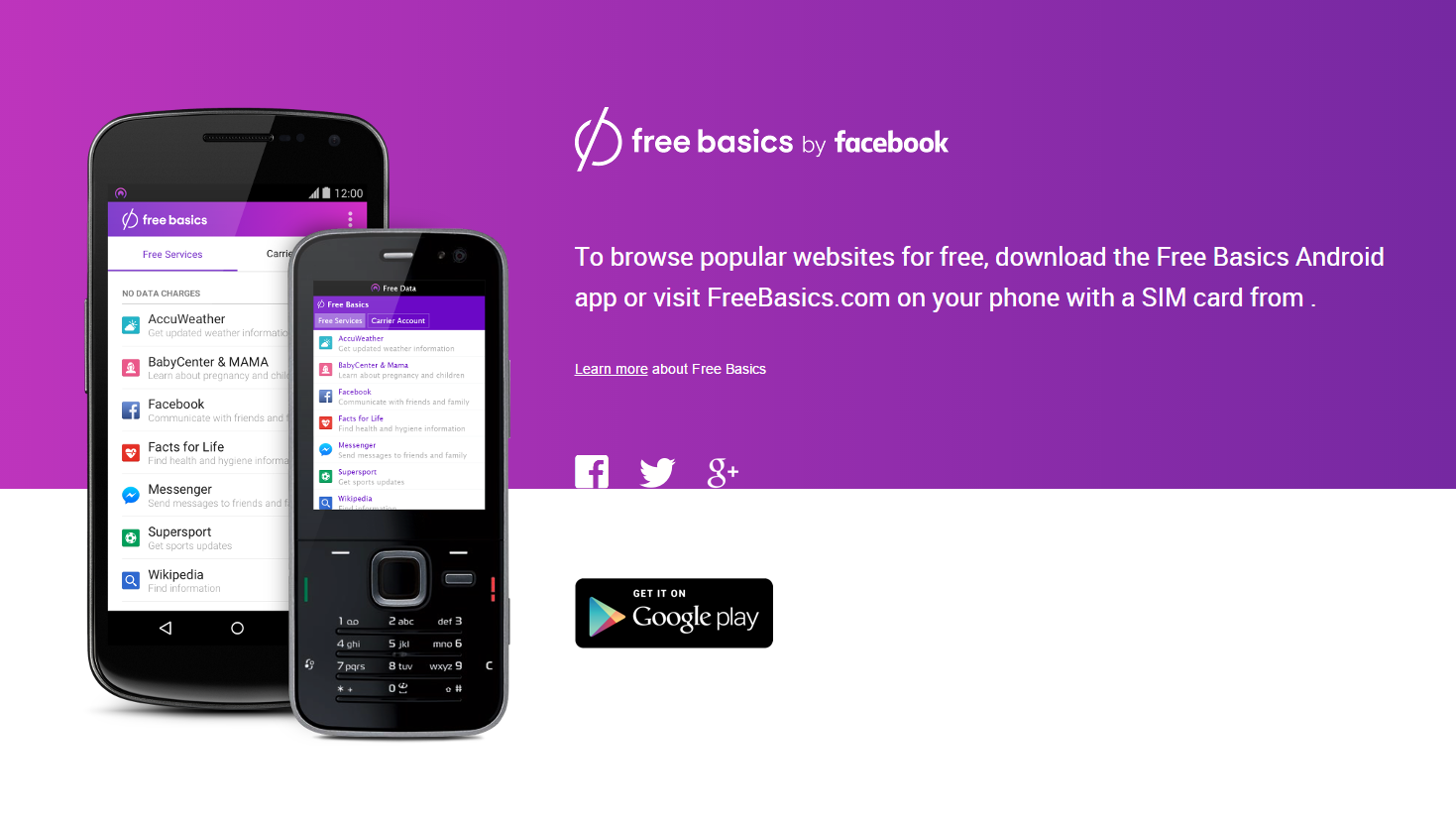
So Mark Zuckerberg-led Facebook has big global ambitions of connecting the world by fast-tracking the reach of the Internet, providing certain free services and by reaching out more people than ever before. Free Basics is a part of that big plan that all comes under Facebook’s Internet.org and what it essentially does is provide a set of online services free of cost to a mobile user. But Facebook gets to pick these free services that it calls ‘basics’.

Now, that’s a problem – it divides the Internet into free and not free elements, it overlooks the notion of net neutrality and it promotes a certain few online services as ‘free’ and ‘basic’. However, Facebook argues that this is like introducing the user to the online world and later they are free to do anything they want. Zuckerberg says Free Basics has to be seen like free primary education or free healthcare, as provided by the state. He argues that something is better than nothing.

Internet.org also adds that the Free Basics programme is running in many other countries, but then these are places where the net neutrality debate is still far, because the net is still not yet around in visible entirety. So the debate can only come alive once that understanding is reached, and than can only happen once a threshold of Internet connectivity and knowledge is acquired along with support from the civil society. Seeing the opposition take on Facebook head is also a good sign for the Indian civil society. But it is the final government or legal call on this debate that’ll decide if it’s a good sign for the Indian democracy.

Apart from the issue around net neutrality, the idea of Free Basics also raises fundamental questions about looking for business solutions to public problems and the evolving role of the private sector in public policy. Photo credit: Facebook


While there are lots of issues people and organisations of all kinds have here, from dividing the Internet to privacy, that are being talked about, this is yet another of those indicators that signals a big shift, towards the evolving nature of capitalism, the changing dynamics of state responsibilities and action, and world politics in general.

Here’s a barrage of questions this debate provokes and some considered thoughts on them:

Who decides what are the basics on the Internet?
This step by Facebook is a big indicator about how the demarcation between who gets to take a call on the elementary services in a respective field is changing. Sure civil societies play a role, but so far, it’s always been states that have deliberated and acted upon when it came to elementary education or health services. But can corporations be the primary partakers when it comes to this? With Free Basics, Facebook has blurred that line on who gets to decide upon what are the ‘basics’ and what goes ‘free’. And clearly then, when the private sector gets involved more questions are asked, irrespective of their validity. In this case, they most certainly are valid. So this essentially marks a shift even in that model of providing basic infrastructure and services with a corporation calling the shots.

So, would it be okay if the government launched Free Basics?
This makes for an interesting hypothesis. It would have raised questions and may not have been allowed to reach the stage of execution, but had the state been the initiator of such a move, it would have lesser resistance. But then, had such a move come, it would have likely been on the back of some version of crony capitalism.

Would it work if it was not called Free Basics?
In that case, Zuckerberg’s argument about clubbing it along with free education or health programmes may not work, but it could have mitigated the opposition perhaps. While free may pass, the use of basics is also a problem. Again, who gives the right to Internet.org to decide what the basics are? Perhaps, had the name been something else that did not make the service seem like the only pathway to the Internet, it could have taken off it India already.

Why call it net neutral?
In that case though, like in the current one, the programme wouldn’t be net neutral. Then why does Facebook insist on calling it that? While there is value in the short-term for many users in what Free Basics offers, in the long-term it means more harm for the structure and accessibility of the Internet. So shouldn’t Facebook just say it isn’t net neutral, and that for now this is a temporary solution which can be scaled back once other net neutral ones kick in?
Perhaps that’d make things easier, because social issues require business solutions, and to begin with they may incline more towards the private sector, but only with strong safeguards and timelines in place to not let capitalism run unregulated in the long=term.

What else can be done then?
Instead of just labeling some services as Free Basics, Internet.org can always work on ways to provide free Internet (something it is attempting to so) and educate new users with other stakeholders to let them choose how they want to use the Internet. Or they can help build the Internet infrastructure in the state.

Let’s also look at the issue from different standpoints, without undermining the fact that irrespective of the number of standpoints or variance in them, these all co-exist, thereby making things more complex. Nothing exists in isolation.

A legal standpoint: Since the Internet is still young and widely not governed by a common set of laws, this is a legal gray area. Then there is the matter where states claim cyber sovereignty and things get murkier further. So these are perhaps the formative years when it comes to the legal basis for the Internet, and this legal foundation must enshrine in it laws that ensure net neutrality.

A financial standpoint: Two things are visible here in terms of what business do or can do. Firstly, business will always look for innovative (ethically right or wrong is another question) ways to grow– and to do so they may want to help society in the short-term with an eye on profits in the long-term. That’s more like a given. The second thing, as pointed above, is that business solutions are needed for certain social problems, but they need to be vetted. While in the short-term they may need nudges and incentives, in the long-term, businesses must never hold the upper hand when it comes to solving social problems.

A social standpoint: Thus, while this episode also exemplifies the need for and an endeavor to provide a business solution to social issues, it is also a reminder of the enormous social challenge that lies ahead globally. Especially in terms of the physical infrastructure that needs to be developed to ensure connectivity and in terms of providing balanced education to entrust users with making the ‘right choices’, even if services like Free Basics exist.

A political standpoint: While this debate illustrates how the Internet is subject to politics when it comes to deciding who gets to write its rules, there’s clear politics at play in terms of designating owners, users and regulators of the Internet because it is today, more than just a tool that promises power and profits.

But the biggest takeaway is also the ever so over powering reach of the private sector when it comes the audacity of private players to not just participate but lead in matters that were until now unquestionably believed to be exclusively under the purview of the state. Thus then, is this another manifestation of the post-national?


While Free Basics doesn’t seem to be the right move ahead, the programme must  not be dismissed without notice and consideration, for it is only through debates and revisions that will pertinent solutions to such problems be invented or discovered. While a public private partnership solution may be best, one may have to remain very wary of that morphing into a private public partnership solution, or solely a private one.